
Spirit-seeking churchgoers are looking to Asian religions
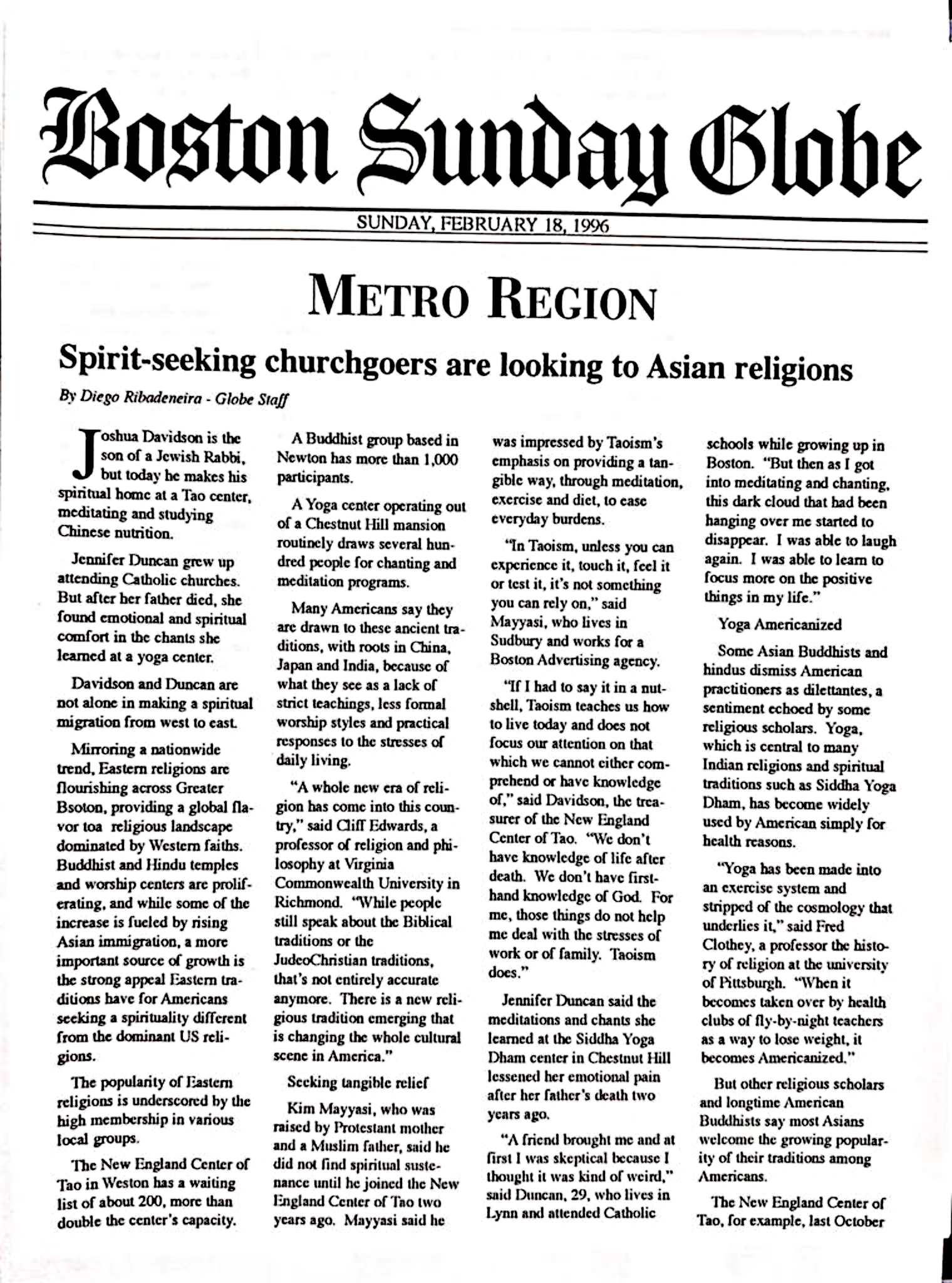
Boston Sunday Globe, METRO REGION
SUNDAY, FEBRUARY 18, 1996
By Diego Ribadeneira – Globe Staff
Joshua Davidson is the son of a Jewish Rabbi, but today he makes his spiritual home at a Tao center, meditating and studying Chinese nutrition.
Jennifer Duncan grew up attending Catholic churches. But after her father died, she found emotional and spiritual comfort in the chants she learned at a yoga center.
Davidson and Duncan are not alone in making a spiritual migration from west to east.
Mirroring a nationwide trend. Eastern religions are flourishing across Greater Boston, providing a global flavor to a religious landscape dominated by Western faiths. Buddhist and Hindu temples and worship centers are proliferating. and while some of the increase is fueled by rising Asian immigration, a more important source of growth is the strong appeal Eastern traditions have for Americans seeking a spirituality different from the dominant US religions.
The popularity of Eastern religions is underscored by the high membership in various local groups.
The New England Center of Tao in Weston has a waiting list of about 200, more than double the center’s capacity.
A Buddhist group based in Newton has more than 1,000 participants.
A Yoga center operating out of a Chestnut Hill mansion routinely draws several hundred people for chanting and meditation programs.
Many Americans say they are drawn to these ancient traditions, with roots in China, Japan and India, because of what they see as a lack of strict teachings, less formal worship styles and practical responses to the stresses of daily living.
“A whole new era of religion has come into this country,” said Cliff Edwards, a professor of religion and philosophy at Virginia Commonwealth University in Richmond. “While people still speak about the Biblical traditions or the Judeo-Christian traditions, that’s not entirely accurate anymore. There is a new religious tradition emerging that is changing the whole cultural scene in America.”
Seeking tangible relief Kim Mayyasi, who was raised by Protestant mother and a Muslim father, said he did not find spiritual sustenance until he joined the New England Center of Tao two years ago. Mayyasi said he was impressed by Taoism’s emphasis on providing a tangible way, through meditation, exercise and diet, to ease everyday burdens.
“In Taoism, unless you can experience it. touch it, feel it or test it, it’s not something you can rely on,” said Mayyasi, who lives in Sudbury and works for a Boston Advertising agency.
“If I had to say it in a nutshell, Taoism teaches us how to live today and does not focus our attention on that which we cannot either comprehend or have knowledge of,” said Davidson, the treasurer of the New England Center of Tao. “We don’t have knowledge of life after death. We don’t have firsthand knowledge of God. For me, those things do not help me deal with the stresses of work or of family. Taoism does.”
Jennifer Duncan said the meditations and chants she learned at the Siddha Yoga Dham center in Chestnut Hill lessened her emotional pain after her father’s death two years ago.
“A friend brought me and at first I was skeptical because I thought it was kind of weird,” said Duncan. 29, who lives in Lynn and attended Catholic schools while growing up in Boston. “But then as I got into meditating and chanting, this dark cloud that had been hanging over me started to disappear. I was able to laugh again. I was able to learn to focus more on the positive things in my life.”
Yoga Americanized
Some Asian Buddhists and Hindus dismiss American practitioners as dilettantes, a sentiment echoed by some religious scholars. Yoga, which is central to many Indian religions and spiritual traditions such as Siddha Yoga Dham, has become widely used by American simply for health reasons.
“Yoga has been made into an exercise system and stripped of the cosmology that underlies it,” said Fred Clothey, a professor the history of religion at the university of Pittsburgh. “When it becomes taken over by health clubs of fly-by-night teachers as a way to lose weight, it becomes Americanized.”
But other religious scholars and longtime American Buddhists say most Asians welcome the growing popularity of their traditions among Americans.