
Ghosts – Guǐ (鬼)
The Taoist View of the Unfinished Souls
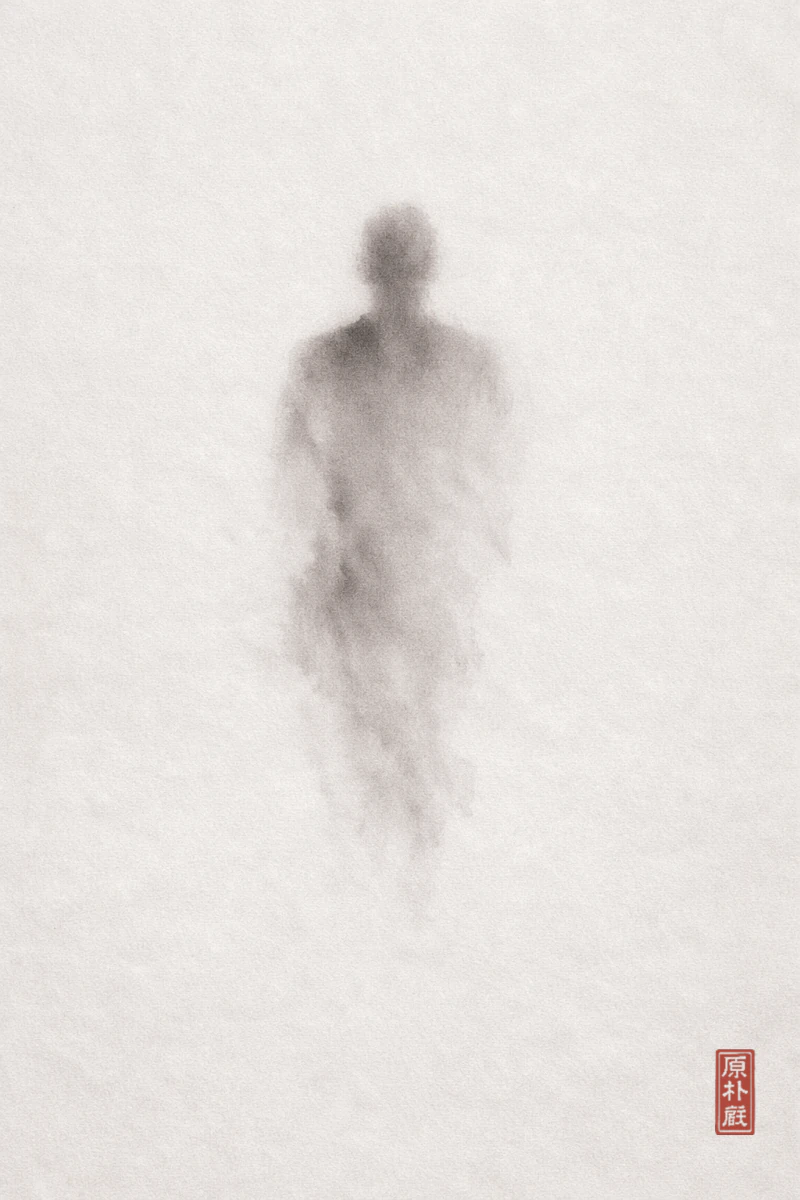
In Taoist tradition, the concept of guǐ is not discussed separately from the teaching on the soul. They are not another class of beings. They are a distortion in the movement of the soul’s components.
If the Taoist teaching on the soul describes the order, then the concept of guǐ describes what happens when that order is interrupted. The soul is the order, the guǐ is a deviation.
As we explained in the article on the Taoist understanding of the soul, a human being does not possess a single, unified soul, but a system of interrelated functions:
- Shen (神) — clarity, presence, conscious order
- Hun (魂) — the lighter, ascending, ethereal aspects
- Po (魄) — the dense, bodily, earthly aspects
When life ends in accordance with the Tao:
- Hun returns upward
- Po returns to the Earth
- Shen dissolves back into the natural order
This is the correct movement. Guǐ appear where this movement fails to complete itself.
What Guǐ are in the Canonical Sense
Guǐ (鬼) are not personal spirits and not conscious entities. Canonically speaking: Guǐ are yin condensations of Po, deprived of the guiding movement of Hun and the ordering clarity of Shen.
Po are, by nature, dense and yin. When they do not return to the Earth, they retain reactivity but lose direction and meaning. That is why guǐ may appear active without possessing awareness.
Why Not Every Death Produces Guǐ
Taoist texts are clear: most people do not become guǐ.
Guǐ arise only when several factors coincide:
- sudden or violent death
- strong attachment to bodily form
- interference with the post-mortem transition
- absence of ritual completion
- prolonged fixation on intense emotion
Guǐ are not the result of death itself, but of an interrupted process.
Canonical Forms of Guǐ as expressions of Po states
Orphaned Po – Gūhún guǐ 孤魂鬼
Po without lineage, name, or ritual anchoring. They are not held by will and gradually disperse on their own. Their presence is felt as emptiness, chill, and lack of form.
Po of Grievance – Yuān guǐ 冤鬼
Formed when Po retains a single unresolved reaction:
- fear
- pain
- injustice
This is not hatred or revenge. It is frozen bodily memory.
Po of Attachment – Zhíniàn guǐ 执念鬼
When Po was excessively strengthened in life through:
- desire
- power
- dependency
After death, such Po continue to hold form. They may appear “aware,” but this is habitual inertia, not the presence of Hun or Shen.
Po of Place – Dì guǐ 地鬼
Here, guǐ are not remnants of individuals, but yin imprints of land. The Earth retains Po just as the body retains traces of trauma.
Artificially Retained Po – Rénzào guǐ 人造鬼
Arising from:
- incorrect ritual action
- attempts to hold or retrieve the soul
- violations of the boundary between realms
Canonical texts regard these forms as the most unstable and disruptive.
What Guǐ Do Not Possess
It is important to state this clearly, Guǐ do not possess:
- full consciousness
- free will
- capacity for learning
- spiritual development
They are not persons. They are residual functions.
Taoist Work with Guǐ
In Taoist teaching, ghosts are not repaired, healed, guided, or transformed. There is no practice aimed at “fixing” a ghost. Taoist rituals and inner work are not directed toward guǐ themselves. They are directed toward the re-establishment of proper movement where it has been interrupted.
These are not techniques or instructions, but descriptions of what becomes possible when alignment is present again. This work focuses on:
- re-establishing the natural movement of Hun, allowing it to rise and disengage
- allowing Po to release and return, without being held in place
- re-establishing the ordering clarity of Shen, so that direction is present again
There is no independent method for this. It occurs as a consequence of alignment, not as a procedure.
Guǐ are not acted upon. They are not addressed, instructed, or changed. When proper movement resumes, there is nothing left that requires intervention. What appeared as a ghost dissolves naturally because it no longer has a condition in which to persist.
Taoism does not approach ghosts as enemies or as beings in need of correction – it approaches interruption itself. There is no combat, no purification of an entity, and no transformation of a spirit. There is only the reopening of a blocked process. When movement completes itself, no residue remains.
Why Taoism Does Not Fear Ghosts
Taoism does not deny the existence of ghosts – it simply does not treat them as enemies.
Fear arises where something is misunderstood. Taoism views ghosts not through imagination but through structure.
Ghosts are not evil beings. In Taoist teaching, ghosts are not demons, not fallen entities, not conscious forces seeking harm. They are unfinished processes. A ghost is not a will. It is not a personality. It is not a thinking phenomenon acting with intent. It is yin energy that did not complete its return.
Fear belongs to disorder, not to ghosts. Taoism observes the world through movement:
- what rises
- what descends
- what returns
- what dissolves
When movement completes itself, there is no disturbance. Ghosts appear only where movement is interrupted. Taoism does not fear interruption. It recognizes it.
A Ghost Is a Sign, not a Threat. In the Taoist view, a ghost is closer to a symptom than to an attacker. It indicates:
- attachment that was not released
- emotion that was not resolved
- transition that was not completed
The ghost does not come to invade. It remains because the path is unfinished. What has no direction cannot conquer. Fear assumes an opponent, but ghosts, in Taoism, do not possess clear intentions, independent will, and the ability to plan or grow. They react; they do not choose. What has no direction cannot dominate what is aligned.
Taoism focuses on completion, not combat. Because ghosts are not enemies, Taoism does not wage war against them. There is no struggle, there is restoration. When order is restored, the ghost dissolves on its own. Not destroyed. Not punished. Simply no longer needed.
Why is the aligned mind unafraid? A person whose Shen is clear, whose Hun are free to move, whose Po are not excessively bound, does not generate fear of ghosts. Because fear itself is a form of internal interruption. Taoism does not teach bravery – it teaches continuity.
Ghosts are frightening only to a worldview that divides the world into attackers and victims. Taoism sees processes, not monsters. Where the path is open, nothing lingers. And where nothing lingers, there is nothing to fear.
Canonical Conclusion
Guǐ are not punishments and not adversaries of the living. They are traces of unfinished movement.
For this reason, Taoist teaching states that where the soul is harmonized in life, guǐ do not arise after death.
Guǐ are not from another world. They are the result of an abruptly stopped process. And this is why working with the soul is the truest prevention of guǐ.