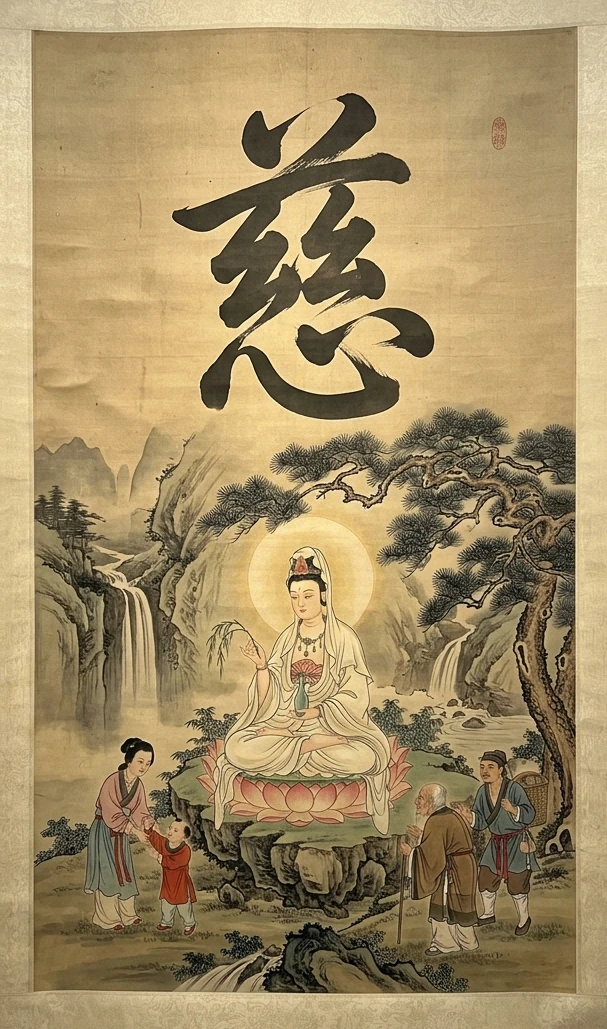
Love – Cí (慈)
Among the great questions that occupy the human mind, none recurs more persistently than the Nature of Love. What does it mean to love someone? What obligations does Love impose, and what are its natural limits? For the Taoist, these are not sentimental puzzles but practical inquiries – answered not by abstraction, but by the laws of Nature itself.
Lao Tzu, in the Tao Te Ching, wrote that Nature is unkind. More precisely, Nature treats creation with utter indifference. And since the sage strives to live in accordance with the laws of Nature, he too, treats creation with utter indifference. This does not mean we Taoists purposely treat people unkindly. Rather, we broadly separate people into two categories: those few people with whom we share common goals, values and ideas (our “cocoon”), and everyone else. We care for our cocoon; we are indifferent to the rest. We also understand that, as humans, we are limited in our capacity to do anything, including Love. Thus, we conserve our Love for only those with whom we share a common affinity.
But what is the Taoist interpretation of “love,” and how does it compare with the socially trumpeted concept of “universal love” often erroneously attributed to Taoism? What is the source of these erroneous interpretations? Perhaps most importantly, how do we as Taoists comport ourselves in Love?
Without proper instruction and understanding, one is likely to misinterpret the Taoist meaning of “love” greatly. Cultural differences affected the accuracy of translations of the Tao Te Ching and can also influence interpretations of terminology. Taoist literature is replete with references to Love, or with passages that may be so interpreted. Chuang Tzu states, “To love one’s fellowman and benefit all is called humanity.” In the Tao Te Ching, Lao Tzu proclaims, “Therefore the Sage puts himself last, and finds himself in the foremost place.” He later declares, “I have Three Treasures…The first is Love…For Love is victorious in attack.” Without delving into the classical meaning of these passages, it is easy to see how an untrained mind could mistakenly believe that Taoism encourages Love of mankind. What then is the Taoist definition of “Love”?
To understand how a Taoist defines Love it helps to understand the language Lao Tzu used 3000 years ago in scribing the Tao Te Ching. The mandarin character commonly interpreted as the word “love” more accurately translates as “simplicity” and “acceptance”. Substitute the word simplicity for Love in Lao Tzu’s passages above, and their apparent meaning changes dramatically
When a Taoist loves someone, it means full acceptance of their virtues and their faults and true compassion for their circumstances in life, in a natural way. At the core of Taoism is romanticism that embraces the concept of Love, but in a distinctly concrete way. Love is a truly beautiful word for the Taoist, for it entails feelings combined with tangible actions. When a Taoist loves someone, he genuinely accepts them and feels compassion toward them naturally.
To love, for the Taoist, is first to accept. One takes the other person exactly as they are. Acceptance asks nothing of the beloved; it seeks no improvement, no conversion, no quiet correction. The loved one is not a project to be finished, nor a flaw to be polished away. A Taoist does not love a person for what they might become, but for what they already are – virtues and faults woven into a single, whole being. To try to reshape a loved one is to reject them in disguise. Acceptance has no such conditions. If you get a dog, you do not expect it to speak like William Shakespeare or Lord Byron. It is a dog. Acceptance is not resignation; it is the adoption of the essence of another, untouched by the urge to remake them.
Caring comes second. It is to express one’s natural desire to care for and preserve that person’s well-being. To care, for the Taoist, is to act without condition and without expectation of return. If the dog is hungry, you feed it. If the dog is sick, you take it to the vet. You look after it simply because it is yours and you are its, not because it has earned your care, nor because you await some reward for giving it. Caring is not a transaction; it is an extension of the self toward another.
Third is naturalness. When acceptance and care must be manufactured, they are no longer acceptance and care but their imitations. Love, for the Taoist, is never forced. It is the most natural and simplistic feeling we know. A loved one becomes a part of you. The mother watching her suckling child understands this connection better than anyone. Love has no intellectual rationalization; it just simply is. Love goes to the core of a person’s essence. It is unexplainable because it is based on the spontaneity of the soul. It is uncontrived, unforced, simple, and from the heart. Loving is as natural an instinct as breathing.
Now compare the Taoist’s concrete definition of Love with the nebulous concepts disseminated by society. Religious institutions, philosophers, politicians, musicians, celebrities, movie directors, and talk-show hosts all preach notions of universal Love yet fail to define their vision for us. Instead, they use vague platitudes such as “love thy neighbour, love thy brother,” “we are the world, we are the children,” and “it takes a village to raise a child” to reinforce the dogma of universal Love. Yet such vagaries don’t translate to real-world applications.
So, even though many people publicly claim to love humanity, most don’t back up their claims with action. To a Taoist, proclamations of Love are secondary to acts of Love. Without action, Love is not Love. Knowing this, Taoists choose to reject the artificial notion of universal Love. Rather, we preserve our Love and our actions only for those in our cocoon, because we understand that, as humans, we have limitations. These limitations govern our capacity to care for more than a very few people. Given such constraints, we make a choice.
Think about this: if the concept of universal Love is natural, why does it have to be taught, and why then are social institutions so eager to teach us how to do it? Do we need to go to a school of breathing? Love is as natural as breathing. There is nothing to learn about it. Could it be that universal Love is not a natural idea?
Universal Love is one of the more absurd notions in society’s portfolio of artificiality. Yet many of the world’s great faiths are built upon this bizarre tenet. They believe that embracing the concept of universal Love will make the world a better place. In theory, we would live without conflict and wars. It is a beautiful concept, but one with no basis in reality.
Is it possible to love the whole world, filled with billions of people whom we do not know? Love is built upon subjective, individual feelings that can only be expressed to a small group of people. Love is personal and private; it cannot be transmitted to the whole world. Universal Love is, therefore, merely an abstract notion, a false construct that does not involve the heart. Worse still, it serves as an easy disguise for insincerity. Thus, it is axiomatic that the bigger the proponent of universal Love, the worse the friend. The two cannot coexist. A universal lover is a lousy friend and unreliable partner in life. Preachers of universal Love spread their own inability to express natural Love to others. Or, worse still, their charade of universal Love is really a calculated means to manipulate you for their own benefit.
As Taoists, we did not design the rules that restrict our capacity to care for a certain number of people; we simply strive to live in accordance with them. By doing so, we avoid the frustration, discontentment, and guilt that most people experience when they fail to meet society’s expectations regarding universal Love. The people who would fault us for our indifference, the “humanitarians,” have no regard for the laws of Nature. As a result, they live confused lives riddled by self-hatred, for they refuse to accept the reality that the laws of Nature are not humanitarian, for “After Tao is lost, then (arises the doctrine of) humanity…”
From the Taoist point of view, the question of whether one truly loves has a remarkably simple answer. Does this person accept you as you are? Does this person care for your well-being? If so, then this person loves you. Love, as the Taoists understand it, requires no grand declarations – only simplicity, acceptance, and the quiet constancy of action.