An Old Philosophy, Translated To West
Unveiling the mysteries of Taoism
Boston Sunday Globe — PEOPLE & PLACES
SUNDAY, JUNE 20,1993
by Marty Carlock Special to The Globe
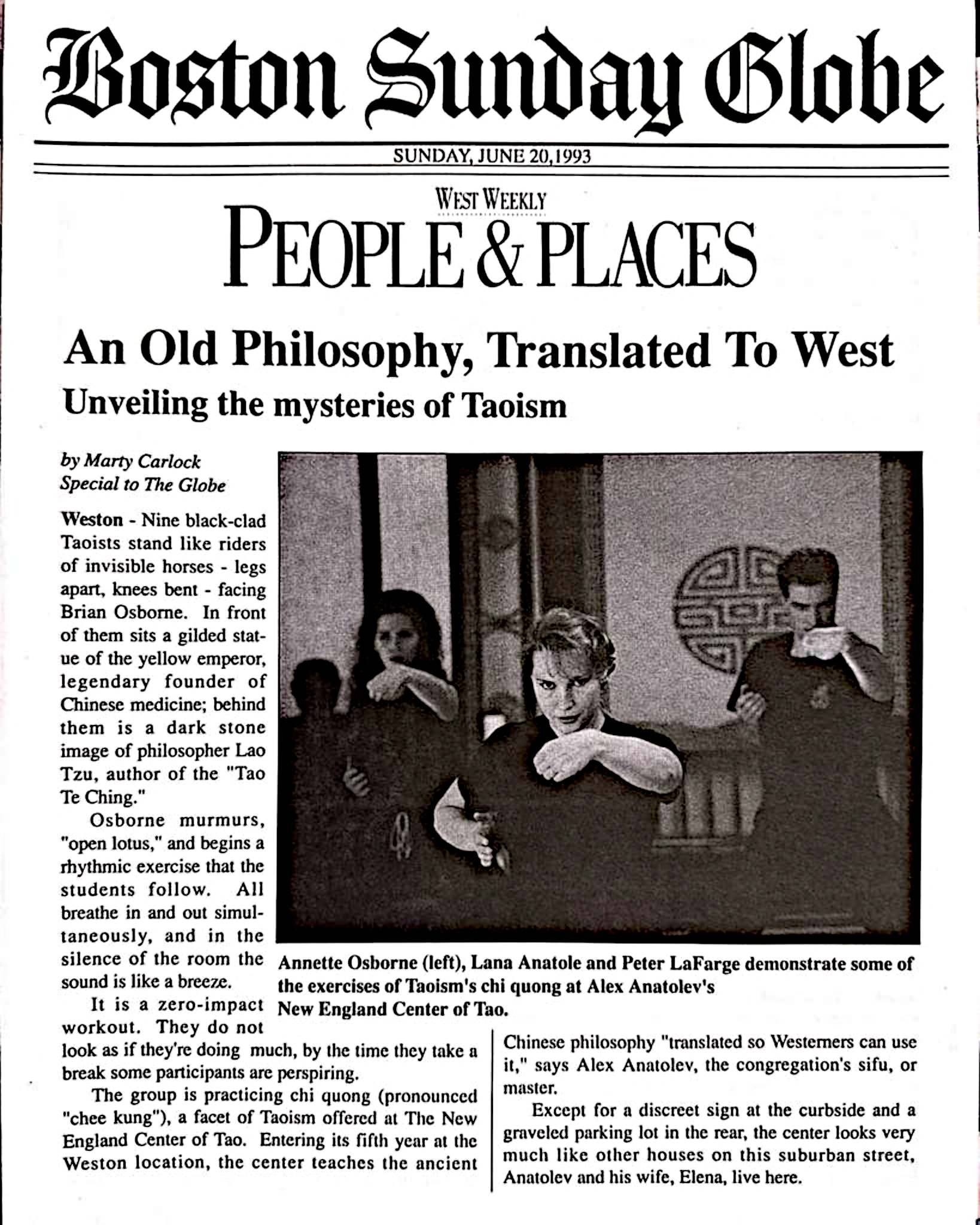
Weston – Nine black-clad Taoists stand like riders of invisible horses – legs apart, knees bent – facing Brian Osborne. In front of them sits a gilded statue of the yellow emperor, legendary founder of Chinese medicine; behind them is a dark stone image of philosopher Lao Tzu, author of the “Tao Te Ching.”
Osborne murmurs, “open lotus,” and begins a rhythmic exercise that the students follow. All breathe in and out simultaneously, and in the silence of the room the sound is like a breeze.
It is a zero-impact workout. They do not look as if they’re doing much, by the time they take a break some participants are perspiring.
The group is practicing chi quong (pronounced “chee kung”), a facet of Taoism offered at The New England Center of Tao. Entering its fifth year at the Weston location, the center teaches the ancient Chinese philosophy “translated so Westerners can use it,” says Alex Anatole, the congregation’s sifu, or master.
Except for a discreet sign at the curbside and a graveled parking lot in the rear, the center looks very much like other houses on this suburban street, Anatole and his wife, Elena, live here.
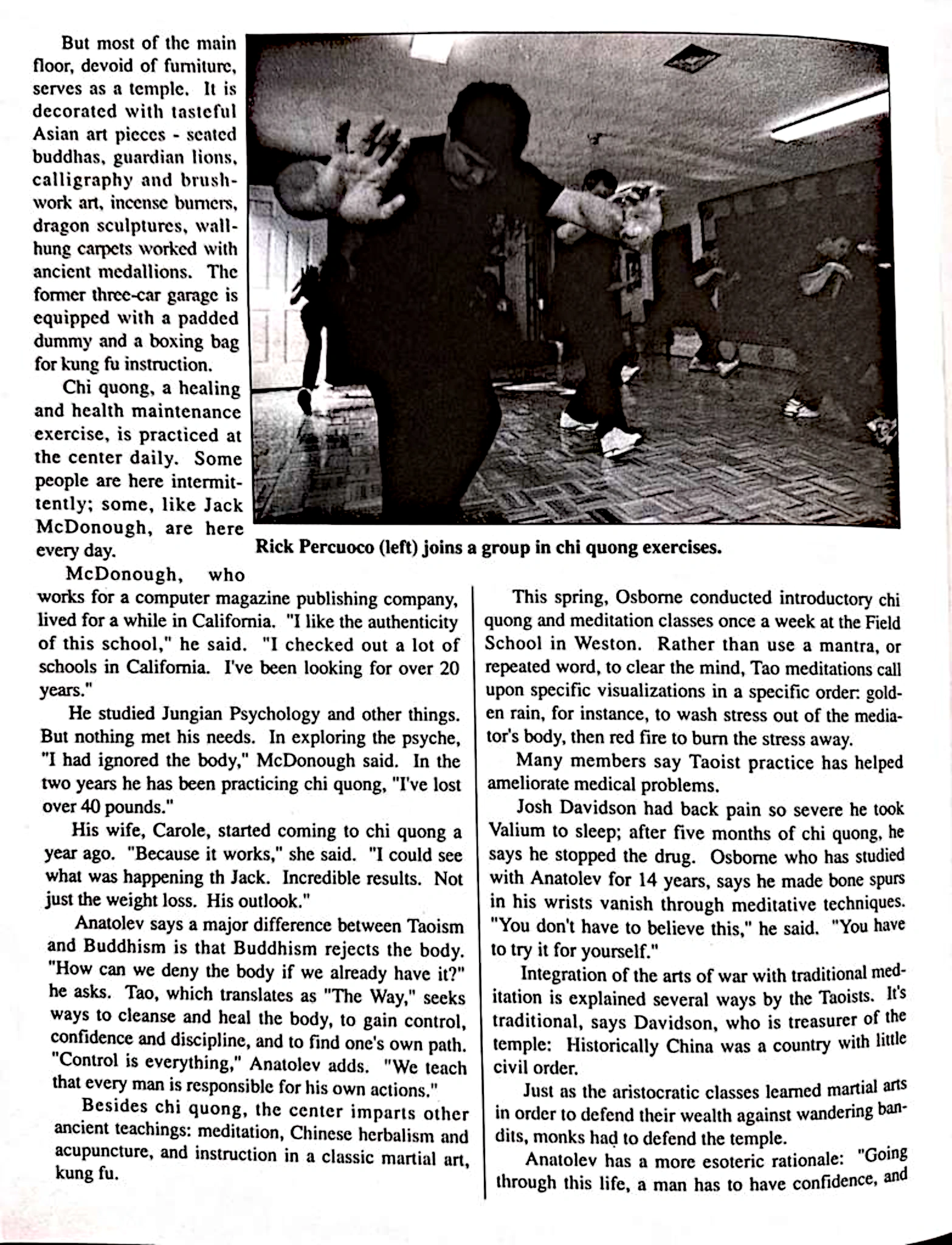
But most of the main floor, devoid of furniture, serves as a temple. It is decorated with tasteful Asian art pieces – seated buddhas, guardian lions, calligraphy and brushwork art, incense burners, dragon sculptures, wall hung carpets worked with ancient medallions. The former three-car garage is equipped with a padded dummy and a boxing bag for kung fu instruction.
Chi quong, a healing and health maintenance exercise, is practiced at the center daily. Some people are here intermittently; some, like Jack McDonough, are here every day.
McDonough, who works for a computer magazine publishing company, lived for a while in California. “I like the authenticity of this school,” he said. “I checked out a lot of schools in California. I’ve been looking for over 20 years.”
He studied Jungian Psychology and other things. But nothing met his needs. In exploring the psyche, “I had ignored the body,” McDonough said. In the two years he has been practicing chi quong, “I’ve lost over 40 pounds.”
His wife, Carole, started coming to chi quong a year ago. “Because it works,” she said. “I could see what was happening to Jack. Incredible results. Not just the weight loss. His outlook.”
Anatole says a major difference between Taoism and Buddhism is that Buddhism rejects the body. “How can we deny the body if we already have it?” he asks. Tao, which translates as “The Way,” seeks ways to cleanse and heal the body, to gain control, confidence and discipline, and to find one’s own path. “Control is everything,” Anatole adds. “We teach that every man is responsible for his own actions.”
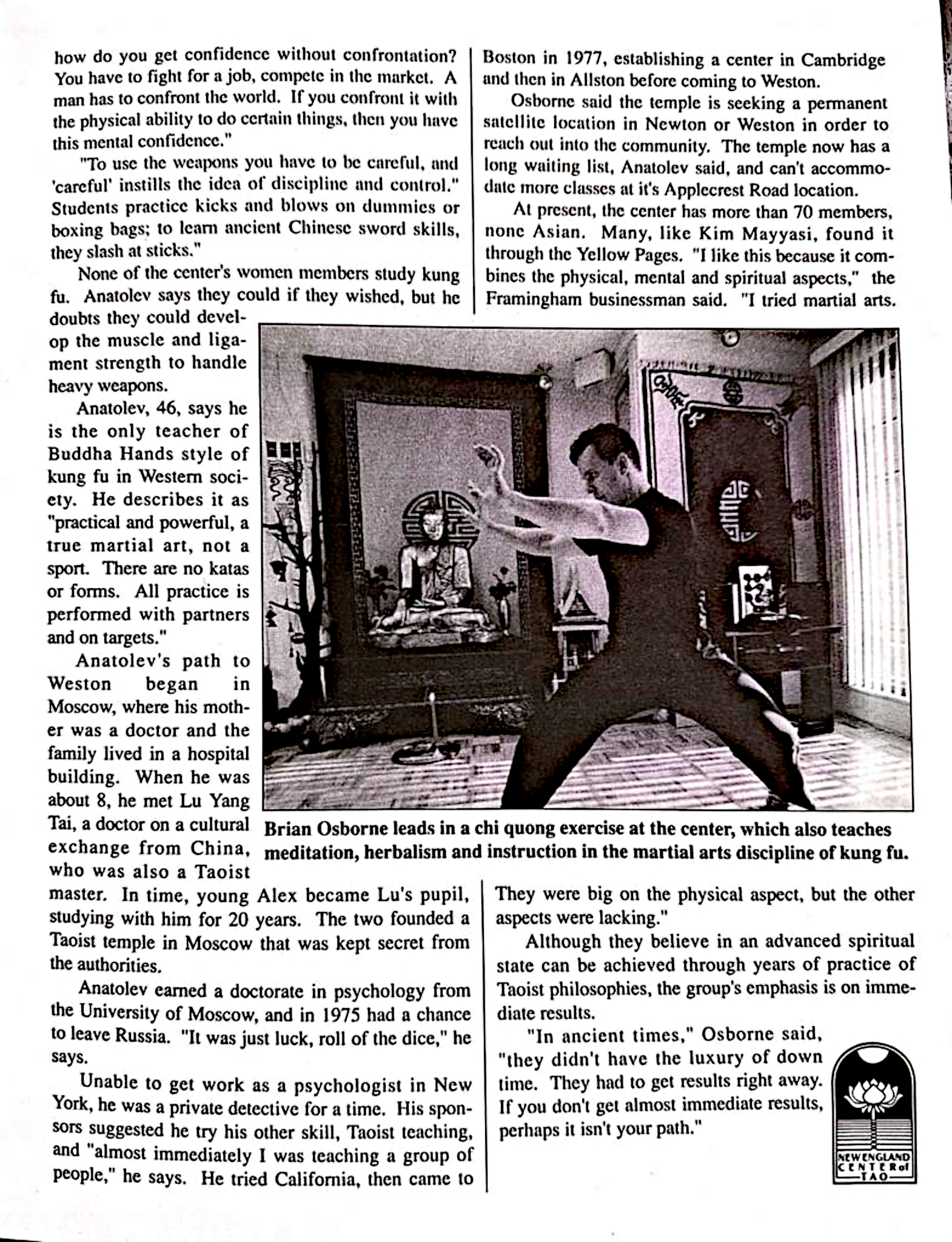
Besides chi quong, the center imparts other ancient teachings: meditation, Chinese herbalism and acupuncture, and instruction in a classic martial art, kung fu.
This spring, Osborne conducted introductory chi quong and meditation classes once a week at the Field School in Weston. Rather than use a mantra, or repeated word, to clear the mind, Tao meditations call upon specific visualizations in a specific order golden rain, for instance, to wash stress out of the mediator’s body, then red fire to bum the stress away.
Many members say Taoist practice has helped ameliorate medical problems.
Josh Davidson had back pain so severe he took Valium to sleep; after five months of chi quong, he says he stopped the drug. Osborne who has studied with Anatole for 14 years, says he made bone spurs in his wrists vanish through meditative techniques. “You don’t have to believe this,” he said. “You have to try it for yourself.”
Integration of the arts of war with traditional meditation is explained several ways by the Taoists. It’s traditional, says Davidson, who is treasurer of the temple: Historically China was a country with little civil order.
Just as the aristocratic classes learned martial arts in order to defend their wealth against wandering bandits, monks had to defend the temple.
Anatole has a more esoteric rationale: “Going through this life, a man has to have confidence, and how do you get confidence without confrontation? You have to fight for a job, compete in the market. A man has to confront the world. If you confront it with the physical ability to do certain things, then you have this mental confidence.”
“To use the weapons you have to be careful, and ‘careful’ instills the idea of discipline and control.” Students practice kicks and blows on dummies or boxing bags; to leant ancient Chinese sword skills, they slash at sticks.”
None of the center’s women members study kung fu. Anatole says they could if they wished, but he doubts they could develop the muscle and ligament strength to handle heavy weapons.
Anatole, 46, says he is the only teacher of Buddha Hands style of kung fu in Western society. He describes it as “practical and powerful, a true martial art, not a sport. There are no katas or forms. All practice is performed with partners and on targets.”
Anatole’s path to Weston began in Moscow, where his mother was a doctor and the family lived in a hospital building. When he was about 8, he met Lu Yang Tai, a doctor on a cultural exchange from China, who was also a Taoist master. In time, young Alex became Lu’s pupil, studying with him for 20 years. The two founded a Taoist temple in Moscow that was kept secret from the authorities.
Anatole earned a doctorate in psychology from the University of Moscow, and in 1975 had a chance to leave Russia. “Il was just luck, roll of the dice,” he says.
Unable to get work as a psychologist in New York, he was a private detective for a time. His sponsors suggested he try his other skill, Taoist teaching, and “almost immediately I was teaching a group of people,” he says. He tried California, then came to Boston in 1977, establishing a center in Cambridge and then in Allston before coming to Weston.
Osborne said the temple is seeking a permanent satellite location in Newton or Weston in order to reach out into the community. The temple now has a long waiting list, Anatole said, and can’t accommodate more classes at its Applecrest Road location.
At present, the center has more than 70 members, none Asian. Many, like Kim Mayyasi, found it through the Yellow Pages. “I like this because it combines the physical, mental and spiritual aspects,” the Framingham businessman said. “I tried martial arts. They were big on the physical aspect, but the other aspects were lacking.”
Although they believe in an advanced spiritual state can be achieved through years of practice of Taoist philosophies, the group’s emphasis is on immediate results.
“In ancient times,” Osborne said, “they didn’t have the luxury of down time. They had to get results right away. If you don’t get almost immediate results, perhaps it isn’t your path.”