Finding the Way
Tao center eases the strains of everyday life
By Josh Clark
TAB Correspondent
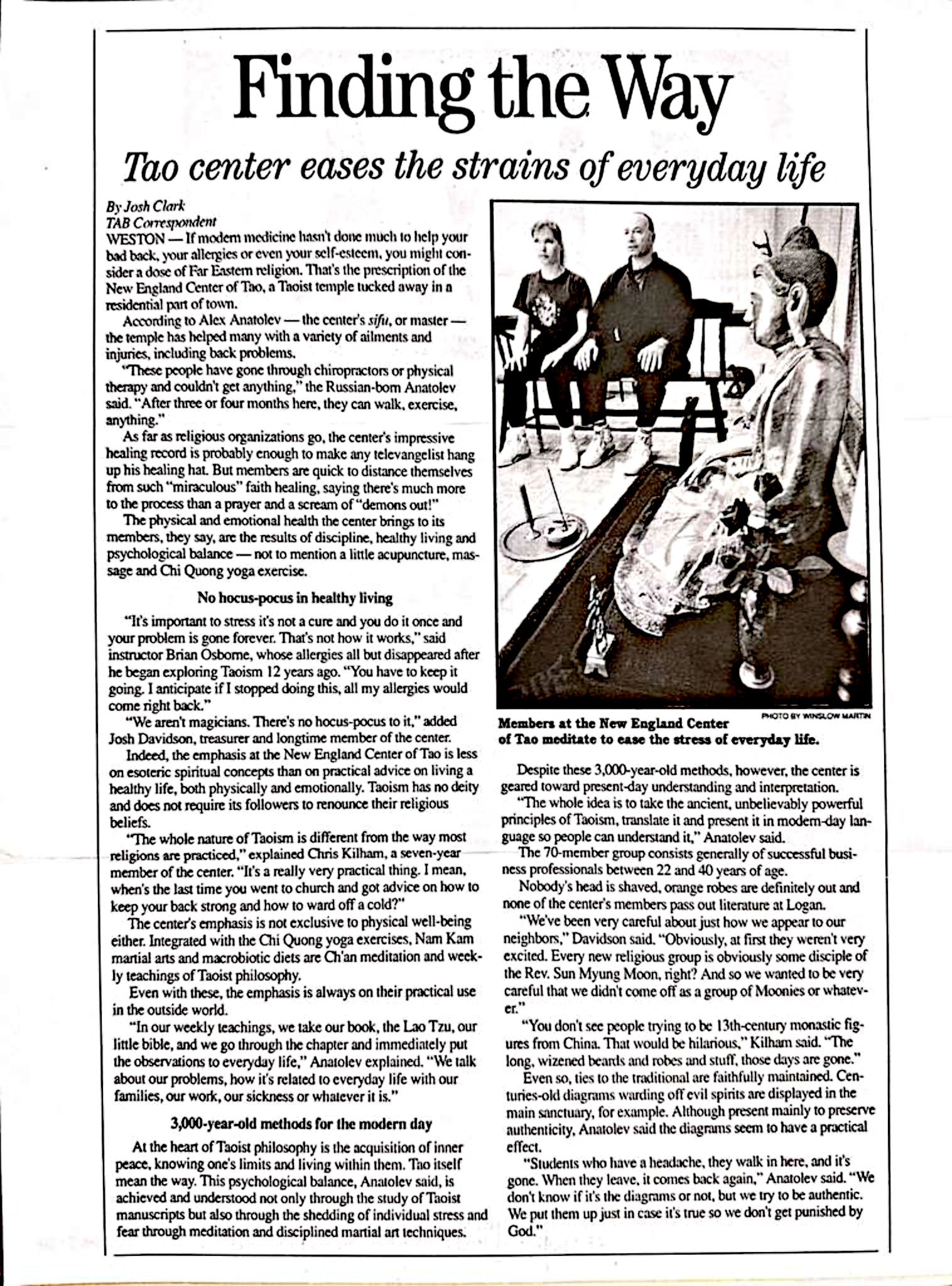
WESTON — If modem medicine hasn’t done much to help your bad back, your allergies or even your self-esteem, you might consider a dose of Far Eastern religion. That’s the prescription of the New England Center of Tao, a Taoist temple tucked away in a residential part of town.
According to Alex Anatole — the center’s sifu, or master — the temple has helped many with a variety of ailments and injuries, including back problems.
“These people have gone through chiropractors or physical therapy and couldn’t get anything,” the Russian-born Anatole said. “After three or four months here, they can walk, exercise, anything.”
As far as religious organizations go, the center’s impressive healing record is probably enough to make any televangelist hang up his healing hat But members are quick to distance themselves from such “miraculous” faith healing, saying there’s much more to the process than a prayer and a scream of “demons out!”
The physical and emotional health the center brings to its members, they say, are the results of discipline, healthy living and psychological balance — not to mention a little acupuncture, massage and Chi Quong yoga exercise.
No hocus-pocus in healthy living
“It’s important to stress it’s not a cure and you do it once and your problem is gone forever. That’s not how it works,” said instructor Brian Osborne, whose allergies all but disappeared after he began exploring Taoism 12 years ago. “You have to keep it going. I anticipate if I stopped doing this, all my allergies would come right back.”
“We aren’t magicians. There’s no hocus-pocus to it.” Added Josh Davidson, treasurer and longtime member of the center. Indeed, the emphasis at the New England Center of Tao is less on esoteric spiritual concepts than on practical advice on living a healthy life, both physically and emotionally. Taoism has no deity and does not require its followers to renounce their religious beliefs.
“The whole nature of Taoism is different from the way most religions are practiced,” explained Chris Kilham, a seven-year member of the center. “It’s a really very practical thing. I mean, when’s the last time you went to church and got advice on how to keep your back strong and how to ward off a cold?”
The center’s emphasis is not exclusive to physical well-being either. Integrated with the Chi Quong yoga exercises, Nam Kam martial arts and macrobiotic diets are Chan meditation and weekly teachings of Taoist philosophy.
Even with these, the emphasis is always on their practical use in the outside world.
“In our weekly teachings, we take our book, the Lao Tzu, our little bible, and we go through the chapter and immediately put the observations to everyday life,” Anatole explained. “We talk about our problems, how it’s related to everyday life with our families, our work, our sickness or whatever it is.”
3,000-year-old methods for the modem day
At the heart of Taoist philosophy is the acquisition of inner peace, knowing one’s limits and living within them. Tao itself means the way. This psychological balance, Anatole said, is achieved and understood not only through the study of Taoist manuscripts but also through the shedding of individual stress and fear through meditation and disciplined martial art techniques.
Despite these 3,000-year-old methods, however, the center is geared toward present-day understanding and interpretation.
“The whole idea is to take the ancient, unbelievably powerful principles of Taoism, translate it and present it in modern-day language so people can understand it,” Anatole said.
The 70-member group consists generally of successful business professionals between 22 and 40 years of age.
Nobody’s head is shaved, orange robes are definitely out and none of the center’s members pass out literature at Logan.
“We’ve been very careful about just how we appear to our neighbors.” Davidson said. “Obviously, at first, they weren’t very excited. Every new religious group is obviously some disciple of the Rev. Sun Myung Moon, right? And so, we wanted to be very careful that we didn’t come off as a group of Moonies or whatever.”
“You don’t see people trying to be 13th-century monastic figures from China. That would be hilarious.” Kilham said. “The long, wizened beards and robes and stuff, those days are gone.”
Even so, ties to the traditional arc faithfully maintained. Centuries-old diagrams warding off evil spirits are displayed in the main sanctuary, for example. Although present mainly to preserve authenticity, Anatole said the diagrams seem to have a practical effect.
“Students who have a headache, they walk in here, and it’s gone. When they leave, it comes back again,” Anatole said. “We don’t know if it’s the diagrams or not. but we try to be authentic. We put them up just in case it’s true, so we don’t get punished by God.”