Taoist Center Plans To Expand
Wants To Create Healing Campus
Town Crier Weston Edition
WEEK OF JULY 28,1994
By Colleen Egan,
Town Crier Correspondent
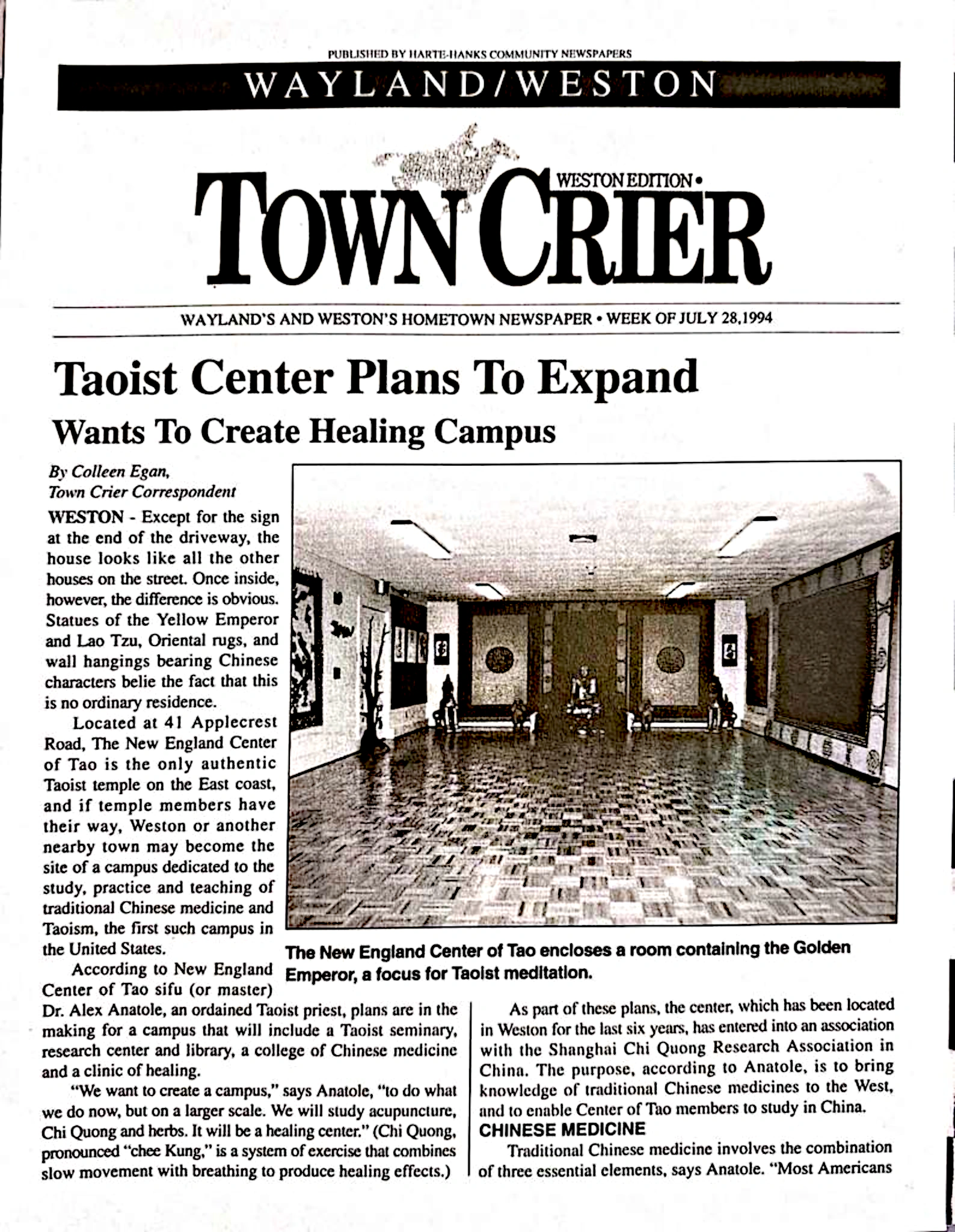
WESTON – Except for the sign at the end of the driveway, the house looks like all the other houses on the street Once inside, however, the difference is obvious. Statues of the Yellow Emperor and Lao Tzu, Oriental rugs, and wall hangings bearing Chinese characters belie the fact that this is no ordinary residence.
Located at 41 Applecrest Road, The New England Center of Tao is the only authentic Taoist temple on the East coast, and if temple members have their way, Weston or another nearby town may become the site of a campus dedicated to the study, practice and teaching of traditional Chinese medicine and Taoism, the first such campus in the United States.
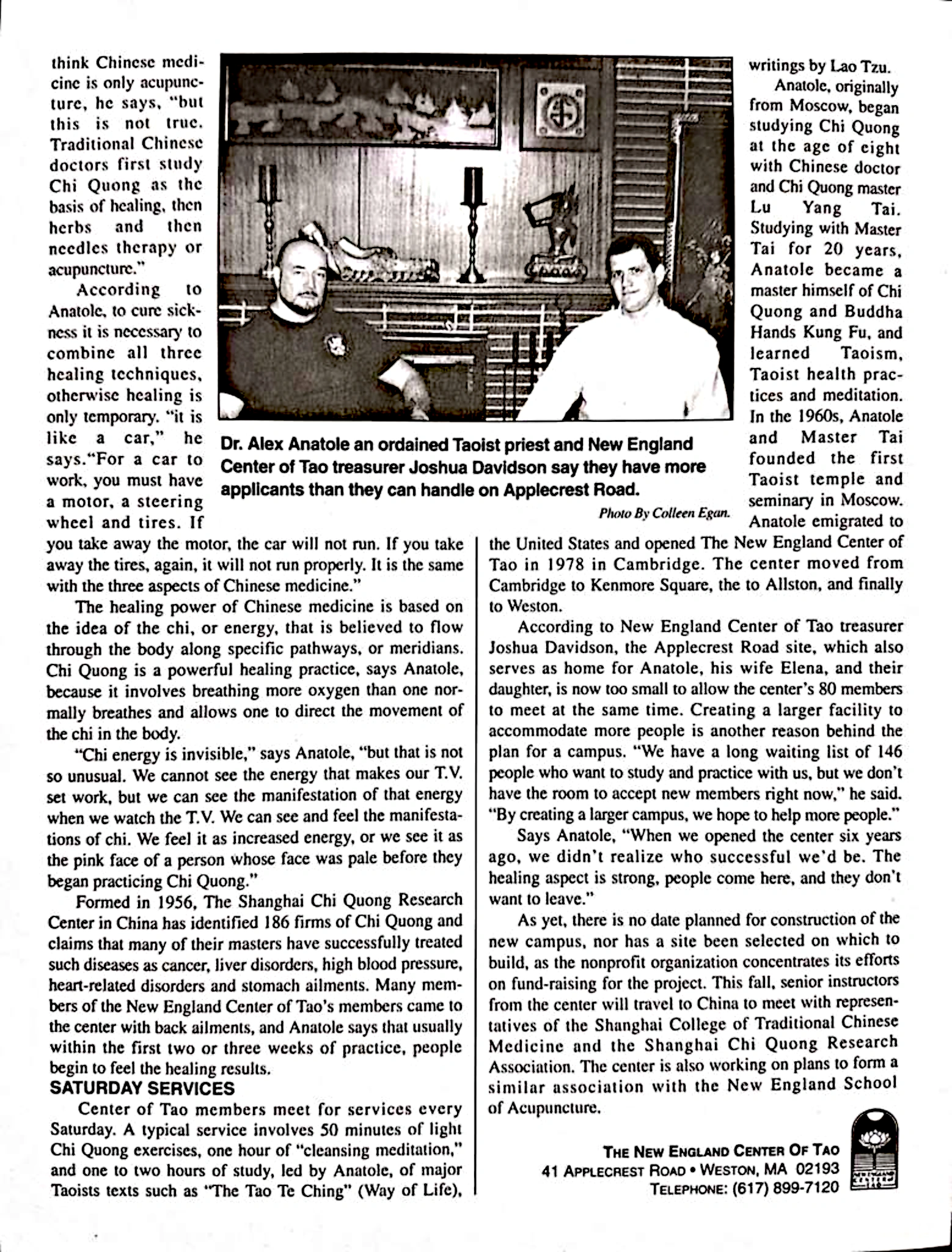
According to New England Center of Tao sifu (or master) Dr. Alex Anatole, an ordained Taoist priest, plans are in the making for a campus that will include a Taoist seminary, research center and library, a college of Chinese medicine and a clinic of healing.
“We want to create a campus,” says Anatole, “to do what we do now. but on a larger scale. We will study acupuncture, Chi Quong and herbs, it will be a healing center.” (Chi Quong, pronounced “chee Kung” is a system of exercise that combines slow movement with breathing to produce healing effects.)
As part of these plans, the center, which has been located in Weston for the last six years, has entered into an association with the Shanghai Chi Quong Research Association in China. The purpose, according to Anatole, is to bring knowledge of traditional Chinese medicines to the West, and to enable Center of Tao members to study in China.
CHINESE MEDICINE
Traditional Chinese medicine involves the combination of three essential elements, says Anatole. “Most Americans think Chinese medicine is only acupuncture,” he says, “but this is not true. Traditional Chinese doctors first study Chi Quong as the basis of healing, then herbs and then needles therapy or acupuncture.”
According to Anatole, to cure sickness it is necessary to combine all three healing techniques, otherwise healing is only temporary, “it is like a car,” he says. “For a car to work, you must have a motor, a steering wheel and tires. If you take away the motor, the car will not run. If you take away the tires, again, it will not run properly. It is the same with the three aspects of Chinese medicine.”
The healing power of Chinese medicine is based on the idea of the chi, or energy, that is believed to flow through the body along specific pathways, or meridians. Chi Quong is a powerful healing practice, says Anatole, because it involves breathing more oxygen than one normally breathes and allows one to direct the movement of the chi in the body.
“Chi energy is invisible,” says Anatole, “but that is not so unusual. We cannot see the energy that makes our T.V. set work, but we can see the manifestation of that energy when we watch the T.V. We can see and feel the manifestations of chi. We feel it as increased energy, or we see it as the pink face of a person whose face was pale before they began practicing Chi Quong.”
Formed in 1956, The Shanghai Chi Quong Research Center in China has identified 186 firms of Chi Quong and claims that many of their masters have successfully treated such diseases as cancer, liver disorders, high blood pressure, heart-related disorders and stomach ailments. Many members of the New England Center of Tao’s members came to the center with back ailments, and Anatole says that usually within the first two or three weeks of practice, people begin to feel the healing results.
SATURDAY SERVICES
Center of Tao members meet for services every Saturday. A typical service involves 50 minutes of light Chi Quong exercises, one hour of “cleansing meditation,” and one to two hours of study, led by Anatole, of major Taoists texts such as “The Tao Te Ching” (Way of Life), writings by Lao Tzu.
Anatole, originally from Moscow, began studying Chi Quong at the age of eight with Chinese doctor and Chi Quong master Lu Yang Tai. Studying with Master Tai for 20 years, Anatole became a master himself of Chi Quong and Buddha Hands Kung Fu, and learned Taoism, Taoist health practices and meditation. In the 1960s, Anatole and Master Tai founded the first Taoist temple and seminary in Moscow. Anatole emigrated to the United States and opened The New England Center of Tao in 1978 in Cambridge. The center moved from Cambridge to Kenmore Square, the to Allston, and finally to Weston.
According to New England Center of Tao treasurer Joshua Davidson, the Applecrest Road site, which also serves as home for Anatole, his wife Elena, and their daughter, is now too small to allow the center’s 80 members to meet at the same time. Creating a larger facility to accommodate more people is another reason behind the plan for a campus. “We have a long waiting list of 146 people who want to study and practice with us. but we don’t have the room to accept new members right now,” he said. “By creating a larger campus, we hope to help more people.”
Says Anatole, “When we opened the center six years ago, we didn’t realize who successful we’d be. The healing aspect is strong, people come here, and they don’t want to leave.”
As yet, there is no date planned for construction of the new campus, nor has a site been selected on which to build, as the nonprofit organization concentrates its efforts on fund-raising for the project. This fall, senior instructors from the center will travel to China to meet with representatives of the Shanghai College of Traditional Chinese Medicine and the Shanghai Chi Quong Research Association. The center is also working on plans to form a similar association with the New England School of Acupuncture.